
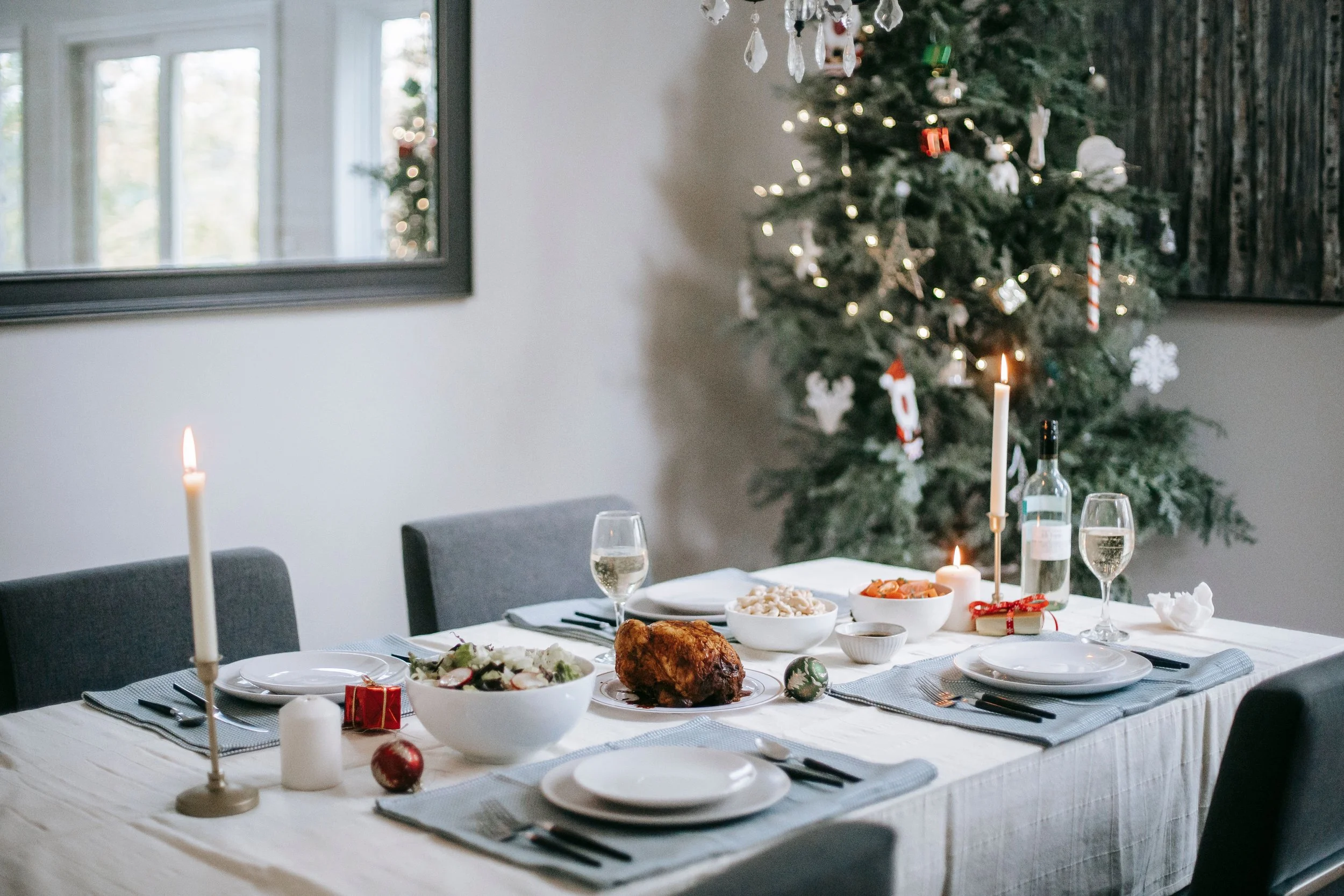
The table is set. Someone laughs at something, and the whole room follows. You laugh a half-second late, and then you notice you are watching it from a distance you cannot name.
Holiday grief rarely announces itself as grief. In high-achieving people it looks like efficiency. The meal gets cooked, the gifts get wrapped, the relatives get coordinated, and every tradition gets carried out correctly while something underneath goes quiet.
If that is your season, this piece is for you. Nothing is wrong with you. You are doing two jobs at once, and only one of them is visible.
The Season Asks You to Perform
The holidays arrive with a script: be grateful, be present, be cheerful. Most people feel the gap between that script and their own inner weather.
In a 2025 American Psychiatric Association poll, 48% of adults said they were worried about missing someone or grief during the holidays, slightly more than the 46% worried about affording or finding gifts. In a LifeStance Health survey of 1,023 adults, nearly 7 in 10 said they feel pressure to appear happier than they are. LifeStance is a mental health provider, so I read its survey as a signal, not a measurement.
For high achievers the pressure has a second layer. The structure that carries you through the year, the deadlines, the routines, the constant motion, slows down in December. In that stillness, whatever you have been managing around starts to catch up.
Why the Holidays Make Grief Louder
Grief does not follow a calendar, but the holidays are built from the things grief attaches to. In an NPR interview, psychologist Mary-Frances O’Connor, who studies grief at the University of Arizona, points out that small details, an empty seat at the table or one less gift to buy, can be jarring reminders of how life has changed.
She also draws a distinction I find useful. Grief is the wave that knocks you off your feet. Grieving is the slower process of adapting to the loss, and your relationship to the wave changes over time. Grief itself can return in a new moment, a wedding or a birthday or a first Thanksgiving without someone, long after the loss. A return of the wave does not mean you have failed to heal. It means a new moment has met an old loss.
O’Connor also notes that anger is a common part of grief, because everything feels turned up, and it often spills onto relationships. If you have been short with your family this season and cannot explain why, that may be what it is.
The Grief Nobody Is Naming at the Table
Not all holiday grief is for a person who has died. There is grief for a relationship that ended this year, a job taken from you and the version of yourself you built inside it, a diagnosis that changed your future, a family you wished you had, another year without the life you wanted. I write about this at length in Grief Nobody Talks About: When the Loss Isn’t a Death.
Researchers call grief that does not receive social recognition disenfranchised grief. A 2025 doctoral dissertation on what its author calls silent grief among Black Christian women describes it as grief that does not align with societal attitudes, which leaves the griever quiet. The author notes that few scholars have studied how Black Christian women experience it. A 2024 paper in the Journal of Racial and Ethnic Health Disparities reports that Black Americans experience bereavement more frequently and earlier in life than white Americans, and that relatively little research has examined the risks and strengths that shape their grief.
In focus groups reported in Frontiers in Psychology, Black women named resilience as their top protective factor and said Black women have historically not prioritized their own mental health. Resilience is real. It is not a substitute for grief that gets processed instead of managed.
What It Looks Like in High Achievers
It does not always look like sadness. It looks like irritability that arrives without warning and lands on the people closest to you. It looks like being unable to settle into a moment even when you are surrounded by people you love. It looks like dreading events you once anticipated, then feeling guilty about the dread. It looks like carrying out every tradition correctly and feeling nothing.
It also looks like being the person who organizes everything and holds the family together, while privately wondering why this year feels heavier than the last. I explore that pattern in The Superwoman Schema Is Not a Compliment and The Mental Health Cost of Being the Strong One in Your Family.
What arrives in November and December is rarely new grief. It is usually old grief that finally has room to be felt.
What Helps, and What Does Not
Pushing through is a common strategy, and it has a built-in limit: it works until the structure of the year falls away, and then everything arrives at once.
What tends to help is smaller and more deliberate. Decide in advance which obligations you will keep and which you will let go. Say out loud, to one person you trust, that this season is hard. Adapt a tradition instead of performing it unchanged: light a candle, tell a story about the person, change who hosts. In my experience, it also helps to plan for the days after the holiday itself, when the demands stop and the quiet sets in.
O’Connor’s summary of the science is worth holding onto: with support and time to learn, people adapt. For those around a grieving person, she says the point is to listen and be present, not to cheer them up.
If what you are carrying feels too heavy to hold alone, that is exactly what grief support is for.
What This Work Looks Like in Practice
Grief work does not ask you to move on, and it does not set a deadline. It starts with making room for the loss alongside the life you are still running: what you feel, where it shows up in your body, and what you have been doing to avoid it. That is part of my work in grief, loss, and life transitions and trauma recovery and emotional healing.
Some of it is slow, and pacing matters. We set it to what you can carry.
My Position, Named Clearly
I do not think grief has a deadline, and I do not think the holidays require you to perform. I also do not treat grief as a problem to be solved by January. It is a response to something that mattered, and my job is to help you carry it, not to talk you out of it.
I work with high-achieving professionals, Black women, and faith leaders who are tired of being the strong one. If you are looking for a plan to feel festive on a schedule, my approach will not be the right fit, and I would rather say so now than have you find out in session. If you want room to feel what you have been managing around, that is the work I do.

Who This Piece Is For
If you are the one hosting, coordinating, and holding everyone else together, this piece is for you. If you are laughing a half-second late at your own family’s table, this piece is for you. If you are grieving someone who died, or something that did not involve a death at all, this piece is for you.
You are allowed to grieve in the middle of a beautiful moment. You are also allowed to protect yourself: to say no to the gathering that costs more than it gives, and to step away from the table when you need to.
Where to Go From Here
If you want support carrying grief through this season, and you live in Virginia, North Carolina, South Carolina, Nevada, Florida, Utah, or Vermont, schedule a consultation. If you are not sure whether what you are feeling is grief, depression, or exhaustion, a consultation is a reasonable place to sort that out.
If you are in crisis or having thoughts of harming yourself, call or text 988.
What People Ask About Grief During the Holidays
-
Yes. The holidays are built from rituals, places, and people that grief attaches to, so small reminders carry extra weight. Grief can also return in a new moment, years after a loss. That is not a sign you have failed to heal. It is a sign that the loss mattered and a new moment has met it.
-
The holidays often slow the structure high-achieving people use to manage emotions during the year: the deadlines, routines, and constant motion. When that structure softens, what has been held at bay has room to surface. Anger is also a common part of grief, and it often shows up as irritability toward the people closest to you.
-
Holiday sadness is tied to triggers like anniversaries and traditions, and it tends to ease as the season passes. Depression involves persistent low mood, lost interest, and trouble functioning that continues beyond the holidays. Prolonged grief disorder applies only to grief after a death, and the DSM-5-TR criteria require at least 12 months to have passed for adults. Psychologist Mary-Frances O’Connor puts it at under 10% of bereaved people. If you are not returning to your baseline, bring that to a clinician.
-
The goal does not have to be getting through. It can be moving through with less pressure to perform a version of the holiday that does not match where you are. Do less. Name what is hard to one person. Adapt a tradition, such as lighting a candle or telling a story about the person, instead of carrying it out unchanged. If it feels too heavy to hold alone, that is what grief support is for.
-
Listen more than you fix. O’Connor says the point is not to cheer a grieving person up but to be with them. Say something direct, such as “I know this season is hard this year, and I am here.” Offer specific help, like a meal or a ride, instead of general availability. And keep checking in after the holiday itself, when the activity stops and the quiet sets in.
Explore further:
If what I described resonates, my grief, loss, and life transitions page speaks directly to this kind of work. I wrote personally about navigating grief in my essay for The Mighty. The pattern of carrying grief while performing strength is something I explore in The Superwoman Schema Is Not a Compliment and Grief Nobody Talks About: When the Loss Isn’t a Death. If what you need is focused, uninterrupted time to actually move through something before the new year, my therapy intensives are designed for exactly that.
